

A strong content strategy can still fail when the work behind it is inconsistent.
Teams may know which topics they want to cover, understand their audience, and have capable writers available. Yet articles still get delayed, reviews become unpredictable, publishing checks are missed, and older content disappears from the team’s attention.
The problem is often not the strategy itself. It is the absence of a repeatable content operations workflow.
A content operations workflow defines how a content opportunity moves from initial research to publication, measurement, and improvement. It establishes the stages work must pass through, the decisions required at each stage, and the people responsible for moving it forward.
The goal is not to create unnecessary bureaucracy. It is to make content production more predictable, preserve context between contributors, and ensure that publishing leads to measurable learning rather than becoming the end of the process.
What Is a Content Operations Workflow?
A content operations workflow is the sequence of stages, responsibilities, rules, and handoffs used to manage content throughout its lifecycle.
It explains how an idea becomes an approved content action, how that action becomes a published page, and how the page is later evaluated and improved.
A workflow may include:
- researching content opportunities,
- prioritizing tasks,
- creating content briefs,
- assigning ownership,
- writing and reviewing content,
- completing publication checks,
- measuring performance,
- and deciding what should happen next.
This is narrower than content operations as a whole. Content operations include the wider system of people, governance, tools, standards, and measurement. The workflow describes the path that individual content actions follow inside that system.
| Content operations | Content operations workflow |
|---|---|
| The wider operating system | The path content work follows inside that system |
| Includes people, governance, tools, and measurement | Defines stages, handoffs, checks, and outcomes |
| Explains how the content function is organized | Explains how an individual content action moves forward |
The Eight Stages of a Repeatable Content Operations Workflow
A practical workflow can be organized into eight connected stages:
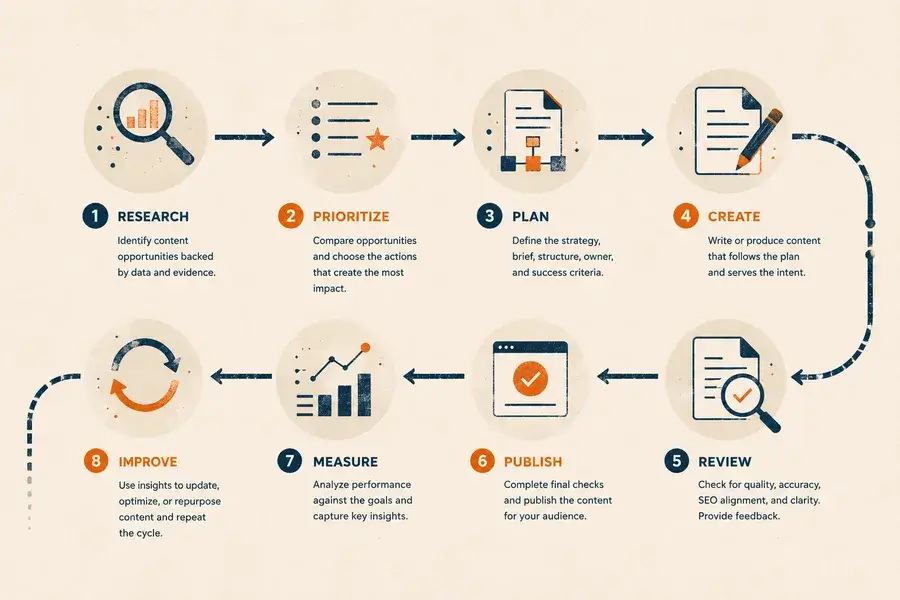
These stages are closely related to the broader SEO workflow, but here the focus is operational: what must happen at each stage, who owns the work, and what output is required before the task moves forward.
1. Research
Research identifies potential content opportunities.
These opportunities may come from keyword data, customer questions, product knowledge, competitor gaps, sales conversations, Google Search Console performance, declining pages, or missing topics within an existing cluster.
The purpose of this stage is not to produce a long list of ideas. It is to document opportunities with enough context to evaluate them.
A useful research record should explain:
- what the opportunity is,
- which audience need it addresses,
- what evidence supports it,
- whether similar content already exists,
- and how it may contribute to business or SEO goals.
The expected output is a clearly described opportunity rather than an unstructured topic suggestion.
2. Prioritize
Not every valid opportunity should become an immediate assignment.
Prioritization compares opportunities based on factors such as relevance, potential impact, urgency, effort, existing coverage, strategic fit, and the strength of available evidence.
Without this stage, teams often work on whichever idea was suggested most recently or presented most confidently.
A prioritization decision should answer two questions:
- Why should this action be completed?
- Why should it be completed now instead of another action?
The expected output is an approved content action with a documented reason for its priority.
3. Plan
Planning converts an approved opportunity into production-ready instructions.
This stage may define:
- the primary keyword,
- search intent,
- the article’s role within a topic cluster,
- its parent keyword or page,
- the intended audience,
- the proposed structure,
- required internal links,
- ownership and due dates,
- and the criteria that will be used to evaluate success.
A weak plan forces writers to make strategic decisions while drafting. A strong plan separates those decisions from the writing task.
The expected output is an approved brief that gives the creator enough direction to work without guessing.
4. Create
The creation stage turns the approved plan into a complete draft.
The writer, editor, or subject-matter expert should follow the agreed scope while preserving room for professional judgment. The brief should guide the work, not reduce it to a mechanical template.
During creation, contributors should avoid expanding into adjacent search intents that belong to separate articles. They should also record unresolved factual questions, missing examples, or areas that require specialist review.
The expected output is a complete draft that is ready for structured review.
5. Review
Review should not be treated as a vague request to “check the article.”
Different types of review serve different purposes:
- Editorial review checks clarity, structure, tone, and readability.
- SEO review checks intent alignment, topical scope, metadata, and internal linking as part of a structured SEO editorial workflow.
- Factual review verifies claims, examples, and technical accuracy.
- Brand review checks messaging, positioning, and terminology.
- Technical review checks formatting, structured data, rendering, and publication requirements.
Not every article needs five separate reviewers. In a small team, one person may perform several of these roles. The important point is that the criteria are explicit.
The expected output is either approved content or a clear, actionable revision request.
6. Publish
Publishing is more than making a page publicly available.
Before publication, the team should confirm that:
- the URL follows the expected structure,
- the meta title and description are complete,
- the page contains the intended internal links,
- images include appropriate alt text,
- heading hierarchy is valid,
- indexing settings are correct,
- the canonical URL is correct,
- and the final page renders properly on relevant devices.
These checks are most reliable when they are standardized. Peekora, for example, can help surface structural issues, cluster relationships, and internal-link gaps before or after publication without treating every recommendation as equally urgent.
The expected output is a technically complete live page, not merely a published draft.
7. Measure
Measurement determines whether the published action produced the expected result.
This stage should begin with a baseline. Without one, teams may see that a metric changed but still be unable to determine whether the content action contributed to that change.
Depending on the objective, useful signals may include:
- search impressions,
- organic clicks,
- click-through rate,
- average search position,
- conversions,
- internal-link visibility,
- engagement metrics,
- or assisted product actions.
Measurement should also use a reasonable observation window. Reviewing a page too early may lead to false conclusions, while waiting indefinitely prevents useful learning.
The expected output is a recorded performance review supported by evidence.
8. Improve
Improvement converts measurement into the next decision.
The correct action may be to:
- refresh outdated information,
- rewrite a weak section,
- improve the title or description,
- strengthen internal links,
- expand missing coverage,
- consolidate overlapping pages,
- change the page’s intended keyword,
- or leave the content unchanged.
Leaving a page unchanged can be a valid decision when the evidence does not support intervention.
The expected output is a documented action or decision that feeds new information back into research and prioritization.
The Content Operations Lifecycle
This diagram visualizes the complete content operations lifecycle as an iterative workflow. It demonstrates how content moves from research and prioritization into planning, creation, editorial review, publication, performance measurement, and continuous improvement before feeding new insights back into future research. The illustration emphasizes that content operations are an ongoing optimization cycle rather than a one-time publishing process.
flowchart
    A[Research] --> B[Prioritize]
    B --> C[Plan]
    C --> D[Create]
    D --> E[Review]
    E --> F[Publish]
    F --> G[Measure]
    G --> H[Improve]
    H --> A
This cycle shows why publishing should not be considered the final stage. Measurement creates evidence, improvement turns that evidence into action, and the resulting insights shape the next round of research and prioritization.
Define Clear Entry and Exit Criteria
A workflow becomes unreliable when no one knows when a stage is complete.
Each stage should have an entry criterion and an exit criterion.
An entry criterion defines what must already be true before work begins. An exit criterion defines what must be completed before the task can move forward.
| Stage | Entry criterion | Exit criterion |
|---|---|---|
| Prioritize | The opportunity includes supporting evidence | The priority decision and reasoning are documented |
| Plan | The content action has been approved | The brief, owner, scope, and success criteria are defined |
| Create | The brief is approved | A complete draft has been submitted |
| Review | The draft meets basic submission requirements | The content is approved or returned with actionable feedback |
| Publish | The content and required assets are approved | The live page has passed technical and editorial checks |
| Measure | Enough time or data has accumulated | The performance review is recorded |
These criteria reduce ambiguity, prevent premature handoffs, and make bottlenecks easier to identify.
Assign Ownership Without Creating Bottlenecks
Every stage should have a clear owner.
Ownership does not mean one person must complete every task. It means one person is responsible for ensuring the stage reaches its expected outcome.
It is useful to distinguish between four roles:
- Owner: responsible for moving the stage to completion.
- Contributor: provides work, knowledge, or supporting materials.
- Reviewer: evaluates the output against defined criteria.
- Approver: makes the final decision when formal approval is required.
| Stage | Typical primary owner |
|---|---|
| Research | SEO specialist or content strategist |
| Prioritize | Content lead, marketing lead, or business owner |
| Plan | Content strategist or editor |
| Create | Writer or subject-matter expert |
| Review | Editor, SEO reviewer, or specialist |
| Publish | Editor or content manager |
| Measure | SEO analyst or content owner |
| Improve | Assigned content owner |
In a solo operation, one person may own every stage. The workflow is still useful because it separates different decisions and prevents important checks from being skipped.
Design Handoffs That Preserve Context
Many workflow problems are actually handoff problems.
A writer receives a keyword without understanding why it matters. An editor sees a draft without knowing which decisions have already been approved. A publisher receives final copy but not the required internal links. An analyst reviews performance without knowing what changed or when.
Each handoff should preserve:
- the original opportunity and supporting evidence,
- the intended audience and search intent,
- the page’s role within the content cluster,
- the decisions already made,
- unresolved questions,
- success criteria,
- and revision history.
When this information travels with the content action, contributors spend less time reconstructing context and are less likely to reverse earlier decisions accidentally.
Build Quality Checks Into the Workflow
Quality assurance is more effective when it happens throughout the workflow rather than only before publication.
Some checks require editorial judgment. Others can be performed deterministically.
Examples of repeatable structural checks include:
- detecting an H1 inside the content body when the article title is already rendered as H1,
- identifying broken heading hierarchy,
- confirming metadata completeness,
- checking the keyword-to-article relationship,
- verifying the parent keyword or cluster relationship,
- confirming required internal links,
- detecting broken links,
- checking image alt text,
- and recording publication and review dates.
Automated checks should reduce avoidable errors, not replace editorial judgment. A system can confirm that an internal link exists, but a person may still need to decide whether the anchor is useful and contextually appropriate.
Keep the Workflow Proportional to the Team
A workflow should create clarity without introducing more administration than the work requires.
For a solo operator
Use a small number of clear stages and record important decisions. One person may research, write, review, publish, and measure, but each stage should still have a distinct purpose.
For a small content team
Focus on ownership, handoffs, review criteria, and reusable templates. Avoid adding approval steps unless they solve a specific risk.
For larger or multi-site teams
Add governance, permissions, project-level visibility, revision history, standardized templates, and reporting across websites or clients.
The workflow should become more detailed only when the operational complexity requires it.
Common Content Workflow Failures
Starting production before prioritization
A topic may be relevant without being the best next action. Skipping prioritization creates busy teams but weak strategic focus.
Treating the brief as optional
When the brief is incomplete, writers must make decisions about intent, scope, structure, and positioning during production. This increases inconsistency and revision time.
Using review as undefined approval
A request to “review this” gives the reviewer no clear standard. Defined review criteria produce more useful feedback and faster decisions.
Making publication the final stage
Without measurement and improvement, the workflow produces pages but does not create organizational learning.
Measuring without a baseline
Performance changes are difficult to interpret when the team has not recorded the starting position or the date of the intervention.
Adding too many stages
More statuses do not automatically create more control. Excessive approvals and handoffs can slow work without improving quality.
Keeping decisions in messages
Important decisions should remain attached to the content record. When context is scattered across chats and emails, teams repeatedly reconstruct the same history.
How to Implement a Content Operations Workflow
You do not need to redesign the entire content organization at once.
- Map the current process. Document what actually happens today, including informal steps and recurring delays.
- Remove unnecessary stages. Keep only the steps that support quality, accountability, or learning.
- Define entry and exit criteria. Make it clear when each stage begins and ends.
- Assign one owner per stage. Contributors may be shared, but responsibility should be explicit.
- Create reusable templates and checks. Standardize briefs, reviews, publication checks, and measurement records.
- Test the workflow on a small set of articles. Avoid forcing an untested process across the entire content library.
- Measure delays and rework. Identify where tasks wait, return to earlier stages, or lose context.
- Revise before scaling. Improve the workflow based on evidence from real use.
How AI Supports a Content Operations Workflow
Artificial intelligence can accelerate several stages of the workflow, but it should operate inside a clearly defined process.
AI can help teams:
- summarize research inputs,
- generate initial brief components,
- detect structural issues,
- identify missing internal links,
- compare content revisions,
- surface declining pages,
- and propose possible next actions.
However, AI should not silently determine priority or approve content without explainable criteria.
The most useful systems combine automation with evidence. They show why an action is being recommended, which data supports it, and what trade-offs the team should consider.
Build a Workflow That Improves With Every Cycle
A content operations workflow is not valuable because it moves every article faster.
It is valuable because it makes work more predictable, preserves decisions between contributors, reduces avoidable rework, and connects publication to measurable learning.
The strongest workflow does not end when a page goes live.
It continues through measurement, improvement, and the next prioritization decision. Over time, each completed cycle gives the team better evidence about what to create, what to update, and which SEO action is most likely to produce meaningful results.
That is how content production becomes a scalable operational system rather than a sequence of disconnected publishing tasks.