
Content problems often begin before the writing starts.
A team may choose a topic because it sounds relevant, assign it to a writer, and move directly into production. Only later does someone realize that the page targets the wrong audience, overlaps with an existing article, lacks a clear search intent, or has no defined role within the wider content strategy.
These are not writing problems. They are planning problems.
A content planning process turns a rough idea into a production-ready content action. It defines why the content should exist, who it should help, which search opportunity it should own, how it fits into the existing content structure, and how success will be evaluated.
The goal is not to create a complicated approval system. It is to make the important decisions before drafting begins, when they are still easy and inexpensive to change.
What Is a Content Planning Process?
A content planning process is the structured sequence of decisions used to prepare a content opportunity for production.
It connects strategy with execution by defining:
- the opportunity being addressed,
- the intended audience,
- the search intent,
- the target keyword,
- the article’s role within a content cluster,
- the scope and structure of the page,
- ownership and responsibilities,
- success criteria,
- and the expected publishing and review timeline.
This process is one part of broader content operations. Content operations define how the organization manages people, processes, standards, and systems. Content planning focuses specifically on the decisions that must be completed before content enters production.
Why Content Planning Matters
Writing is expensive to redo.
When a content team discovers a strategic problem after the first draft, it may need to rewrite the article, change the target keyword, restructure the page, or abandon the work entirely.
A clear planning process reduces this risk by resolving the most important questions early.
It helps teams avoid:
- publishing multiple pages for the same search intent,
- creating content without a clear audience,
- assigning topics that do not support business goals,
- writing briefs that leave strategic decisions to the writer,
- targeting keywords that already belong to another page,
- and measuring performance without knowing what success was supposed to mean.
Planning also improves collaboration. Writers receive clearer direction, editors understand the intended outcome, and SEO reviewers can evaluate the page against decisions that were documented before production began.
The Core Stages of a Content Planning Process
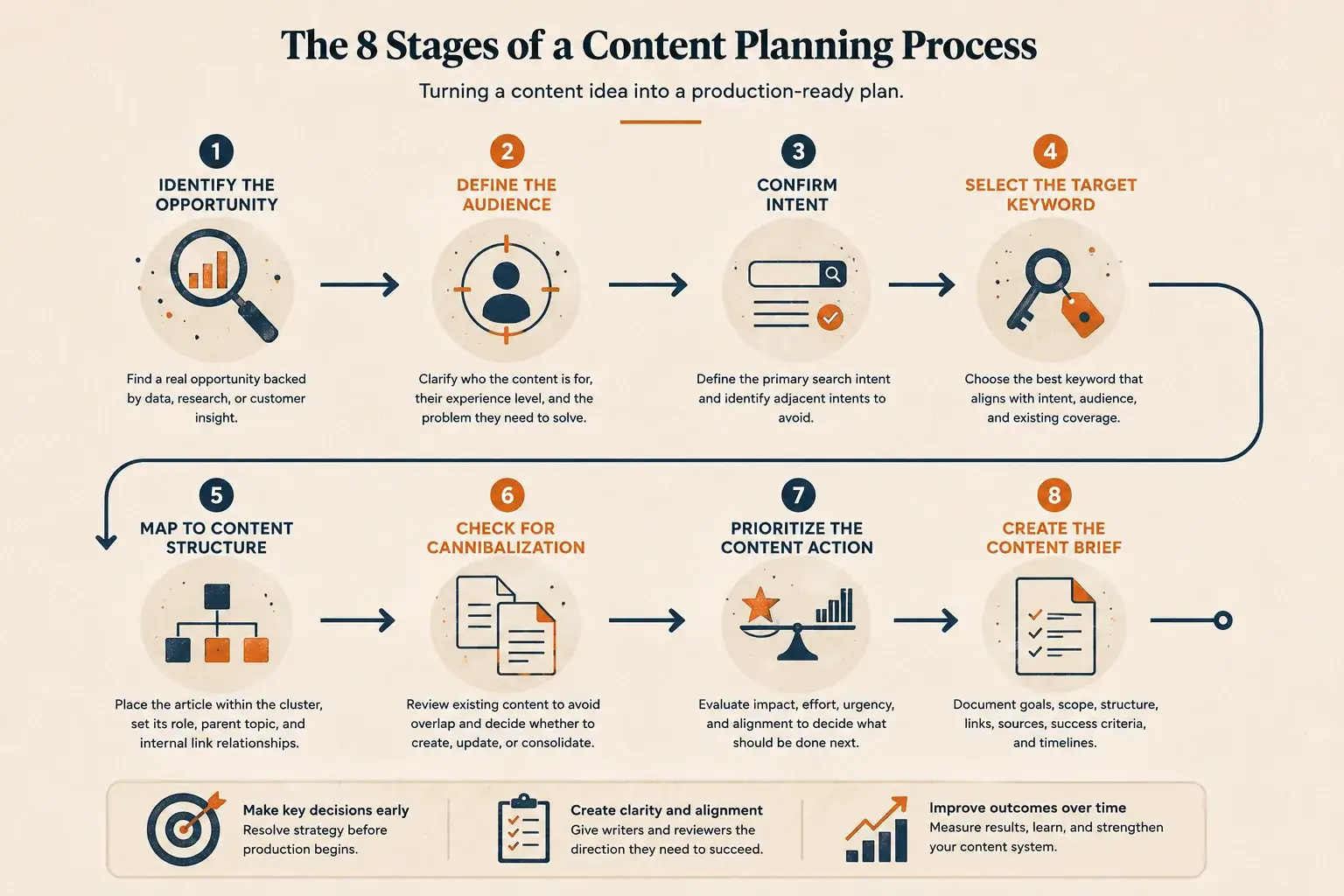
A practical content planning process can be organized into eight stages:
Each stage should produce a clear decision. By the end of the process, the content should be ready to enter the broader content operations workflow.
1. Identify the Content Opportunity
Planning should begin with an opportunity, not merely a topic.
A topic describes what the content might discuss. An opportunity explains why the content should exist.
Content opportunities may come from:
- keyword research,
- Google Search Console data,
- customer questions,
- sales conversations,
- competitor gaps,
- missing topics within a cluster,
- declining content,
- or new product and market developments.
The opportunity record should describe the evidence behind the idea.
For example, “write an article about content planning” is only a topic. “Create a guide for teams searching for a repeatable content planning process because the current cluster covers operations and editorial workflow but not pre-production planning” is an opportunity.
2. Define the Intended Audience
Before deciding how the article should be structured, define who it is for.
A page written for a solo founder may require a different level of detail from a page written for an agency, enterprise content team, or experienced SEO professional.
The audience definition should clarify:
- the reader’s role,
- their level of experience,
- the problem they are trying to solve,
- what they likely already understand,
- and what action they should be able to take after reading.
A useful audience description is specific enough to guide the article but broad enough to reflect the real search market.
3. Confirm Search Intent
Search intent describes the outcome a user expects when entering a query.
Two keywords may appear closely related while requiring different pages because the underlying intent is different.
For example:
- “content operations” usually requires a broad explanation of the operating system behind content work,
- “content operations workflow” requires a practical lifecycle and handoff model,
- and “content planning process” requires a guide to the decisions made before production begins.
Planning should define the primary intent and identify any adjacent intents the article should avoid owning.
This prevents the draft from expanding into topics that belong to separate pages.
4. Select the Target Keyword
The target keyword should represent the primary search intent the page is designed to satisfy.
Keyword selection should consider:
- relevance to the audience and business,
- alignment with the intended page type,
- existing rankings and impressions,
- current site coverage,
- competitive difficulty,
- and whether another page already owns the query.
One article should have one clear keyword owner.
Related terms can be covered naturally, but they should not create uncertainty about the page’s primary role.
5. Map the Article to the Content Structure
Every planned article should have a defined position within the website’s content architecture.
This may include:
- the content cluster,
- keyword type,
- parent keyword,
- article content type,
- required parent link,
- and relevant sibling relationships.
For example, a secondary article should support its parent topic rather than attempt to replace it.
Mapping this relationship before writing helps prevent duplicate coverage and makes future internal linking easier.
| Planning field | Question it answers |
|---|---|
| Cluster | Which wider topic does this article support? |
| Keyword type | Is this a pillar, primary, or secondary topic? |
| Parent keyword | Which broader page should this article support? |
| Content type | Should this page be a guide, comparison, checklist, or another format? |
| Internal links | Which existing pages should connect to and from this article? |
6. Check for Cannibalization and Overlap
Before approving a new article, review existing content for intent overlap.
Keyword cannibalization occurs when multiple pages compete for the same or very similar search intent. This can weaken page ownership, create confusing internal signals, and make future optimization more difficult.
The planning process should ask:
- Does an existing page already answer this query?
- Would updating an existing article be more useful than publishing a new one?
- Is the proposed angle distinct enough to justify a separate URL?
- Could two planned keywords be served by the same article?
- Would the new page compete with its parent?
If the distinction cannot be explained clearly, the content should not enter production yet.
7. Prioritize the Content Action
A valid content opportunity is not automatically the best next action.
Prioritization should compare the opportunity with other available work based on:
- business relevance,
- search potential,
- current ranking position,
- topical importance,
- effort required,
- dependencies,
- urgency,
- and expected impact.
The planning record should include a short explanation of why the article is being created now.
This makes the decision easier to review later and prevents the content calendar from becoming a list of unexamined ideas.
8. Create the Content Brief
The brief is the main output of the content planning process.
It should contain enough information for the writer to begin without making unresolved strategic decisions during drafting.
A practical content brief may include:
- working title,
- target keyword,
- search intent,
- intended audience,
- article goal,
- cluster and parent relationship,
- scope boundaries,
- recommended headings,
- required internal links,
- important questions to answer,
- source requirements,
- visual requirements,
- and success criteria.
The brief should guide the writer without attempting to pre-write the article.
Too little direction creates inconsistency. Too much direction can reduce the writer to filling predetermined sections without thinking about the reader.
Define Success Before Production Begins
A content plan should explain how the team will decide whether the article succeeded.
The correct success criteria depend on the page’s purpose.
Possible measures include:
- ranking for the intended query,
- growth in impressions or clicks,
- improved click-through rate,
- qualified conversions,
- support for a topical cluster,
- internal-link distribution,
- sales or support enablement,
- or successful replacement of an outdated page.
The team should also record a baseline where relevant. Without a starting point, later measurement may show movement without explaining whether the content action created meaningful improvement.
Assign Ownership and Timing
A content plan is incomplete until someone owns the next step.
The planning record should define:
- who owns the article,
- who will write it,
- who will review it,
- who approves publication,
- the expected production date,
- the planned publication date,
- and the first performance review date.
This does not require a large team. A solo operator may fill every role. The value comes from making each responsibility and date explicit.
Once production begins, the content should move into the relevant editorial stages defined in the SEO editorial workflow.
Common Content Planning Mistakes
Starting with a keyword and nothing else
A keyword does not explain the audience, intent, article role, or reason for priority.
Keyword data should inform the plan, not replace it.
Leaving strategic decisions to the writer
Writers should make editorial decisions, but they should not be expected to determine the page’s keyword ownership, cluster role, business goal, and success criteria while drafting.
Planning new content before reviewing existing pages
The best content action may be an update, consolidation, or intent correction rather than a new article.
Using the editorial calendar as the entire plan
A calendar answers when something will be published. It does not explain why the article should exist or how it should be created.
Skipping cannibalization checks
Publishing a new page without checking current coverage can create competition between pages that should support one another.
Defining success after publication
If the team decides what success means only after seeing the results, the evaluation can easily become biased.
A Practical Content Planning Checklist
Before moving an article into production, confirm that the following questions have clear answers:
- Why should this content exist?
- What evidence supports the opportunity?
- Who is the intended reader?
- What problem or question are they trying to resolve?
- What is the primary search intent?
- Which keyword should this page own?
- Which cluster and parent topic does it belong to?
- Does an existing page already cover the same intent?
- Why is this the right content action to prioritize now?
- What must the article include?
- What should it deliberately avoid covering?
- Who owns production, review, and publication?
- How will success be measured?
- When will the page be reviewed after publication?
If these questions are answered, the content idea has become production-ready.
Plan the Decision Before You Plan the Draft
A strong content planning process does not begin with headings.
It begins with a decision.
The team must first determine why the content should exist, who it should help, which opportunity it should own, and how it fits into the larger content system.
Only then should the brief, structure, schedule, and assignment be created.
This approach reduces rework, improves keyword ownership, protects cluster integrity, and gives every contributor a clearer understanding of the expected outcome.
The purpose of content planning is not to predict every sentence before writing begins.
It is to remove strategic uncertainty so the writer can focus on creating the most useful possible page.